Carried out in 2022 and 2023 in Lleida, Segovia, Guadalajara and Cuenca. Around 184 individuals, less than expected according to previous data
During the springs of 2022 and 2023, the LIFE Connect Ricotí project conducted a thorough census of the Dupont’s lark to characterize the initial status of its populations in the project localities, with the aim of assessing the effect of habitat management measures to be implemented. To this end, censuses have been conducted in the Secans de Mas de Melons-Alfés SPA (Lleida), the Hoces del Río Riaza SPA (Segovia), the Hoces del Río Duratón SPA (Segovia), the Parameras del Maranchón, Hoz del Mesa, and Aragoncillo SPA (Guadalajara), the Lagunas y parameras del Señorío de Molina SPA (Guadalajara), the Rentos de Orchova y vertientes del Turia SPA (Cuenca), and the Hoz del Río Gritos y Páramos de las Valeras SPA (Cuenca).
In the case of the Dupont’s lark, the length of transects is a crucial aspect to obtain reliable data, as the species’ singing activity reaches its peak during the 20-45 minutes prior to sunrise. Transects longer than 3 km cannot be covered in this time, which could reduce the detection capacity of individuals at the end of censuses and generate an underestimation of populations. Therefore, the average length of transects was 1.8 km (0.8 km – 2.8 km) and the bandwidth was 500 meters on each side of the transect. Census in the locality of Pedro Izquierdo (Cuenca), where there is no record of the species’ presence, were conducted using automatic recorders.
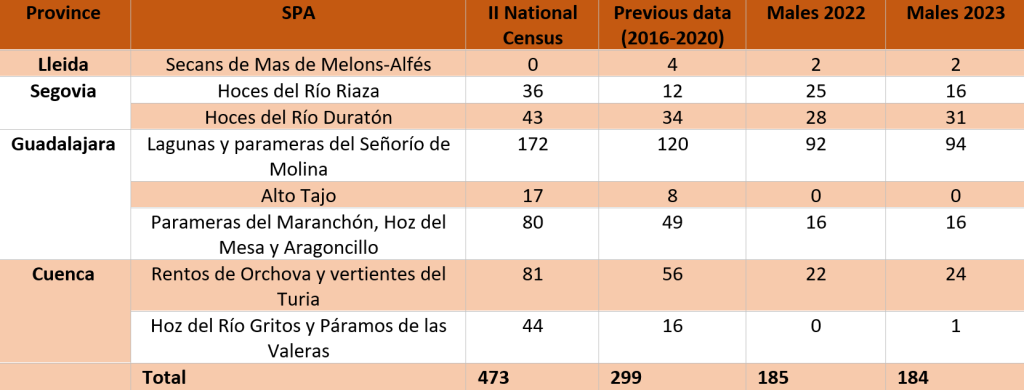
The initial results of the 43 census conducted show that the minimum number of males counted within SPAs in 2022 and 2023 was 185 and 184 respectively (a lower number than expected according to previous data). During 2024, the same 43 census will be repeated, in addition to those corresponding to the monitoring (Post Life) of the actions carried out during the years 2017-2019 within the framework of the LIFE-Ricotí project. We are eager to know the status of the populations of Retortillo de Soria, Barahona, and Arbujuelo where habitat management and promotion of livestock activity measures were applied at the time.
We will keep you informed and hope to bring good news that will be of vital importance for the well-being of a species classified as “Endangered” in the Spanish Catalogue of Threatened Species.
Table 1. Summary of the historical evolution of Dupont’s lark males within the SPAs belonging to the four Autonomous Communities studied.