
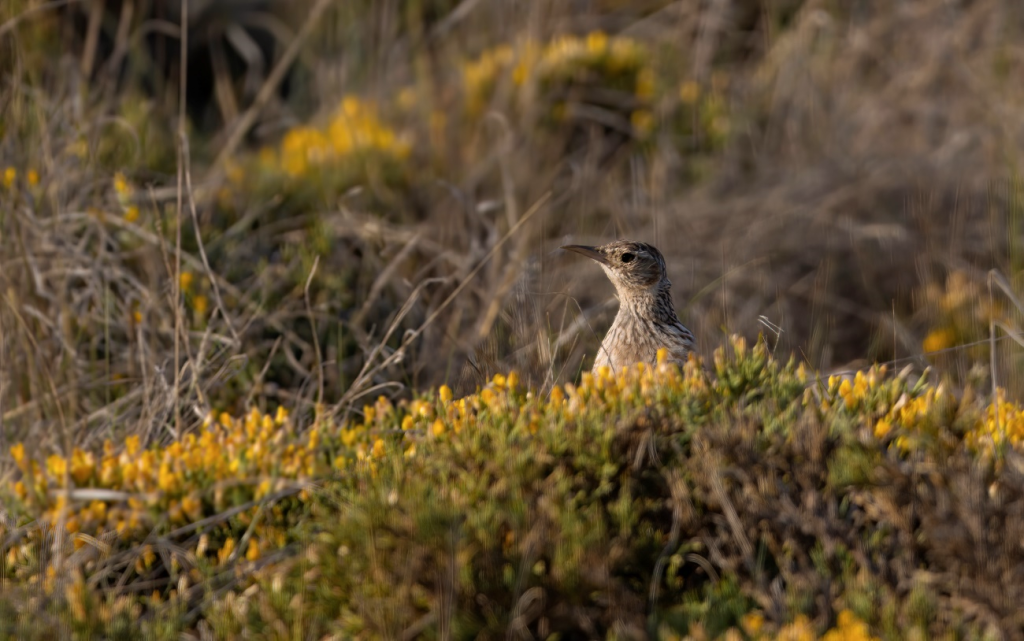
The LIFE Connect Ricotí project continues to conduct detailed censuses of the Dupont’s lark, updating the surveys from previous springs in spring 2024. These studies aim to assess the current status of the species’ populations and measure the impact of habitat conservation efforts (Figure 1).
One of the most crucial factors in these censuses is the length of the transects (the routes traveled by observers), as the Dupont’s lark exhibits peak vocal activity just before dawn. For this reason, the transects were designed to not exceed 2 km, allowing researchers to cover the necessary distance without missing key data.
On average, transects were 1.8 km long and 500 meters wide on each side. In Pedro Izquierdo, Cuenca, where the species had not been previously recorded, automatic recorders were used to detect any signs of Dupont’s lark after habitat improvements.
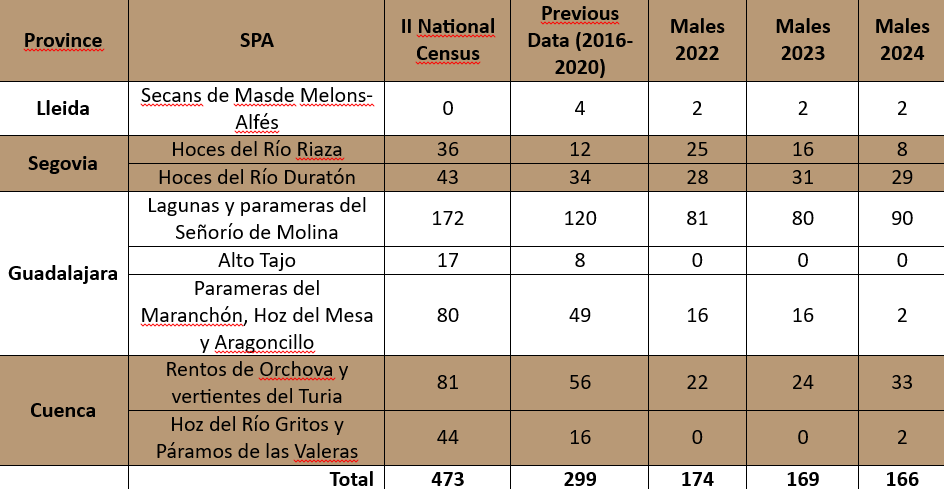
Initial results from the 43 censuses show similar figures: in 2022 and 2023, 174 and 169 males were counted in the Special Protection Areas for Birds (SPA), a number lower than expected compared to data from previous censuses. In 2024, 166 territories were recorded, a slight decrease from the previous two years.
Some of the most relevant data from spring 2024, focusing on the SPA areas (see historical evolution in Table 1), include: 2 males in Secans de Mas de Melons-Alfés, 8 in Hoces del Río Riaza, 29 in Hoces del Río Duratón, 90 in Lagunas and Parameras del Señorío de Molina, 2 in Parameras del Maranchón, 33 in Rentos de Orchova and the Turia slopes, and 2 in Hoz del Río Gritos and Páramos de las Valeras.
Additionally, 37 males (compared to 34 in 2023) were detected outside the ZEPAs, including 13 (14 in 2023) in Tortuera and 24 (20 in 2023) in Miedes de Atienza and Bañuelos, leaving the total number of territories in 2024 similar to that in 2023.
The LIFE Connect Ricotí project team will continue monitoring Dupont’s lark populations in spring 2025, at which time they expect to obtain initial results regarding the impact of recent habitat restoration efforts. These new censuses will allow for a more precise evaluation of the effectiveness of implemented measures and their contribution to the recovery of this endangered species.