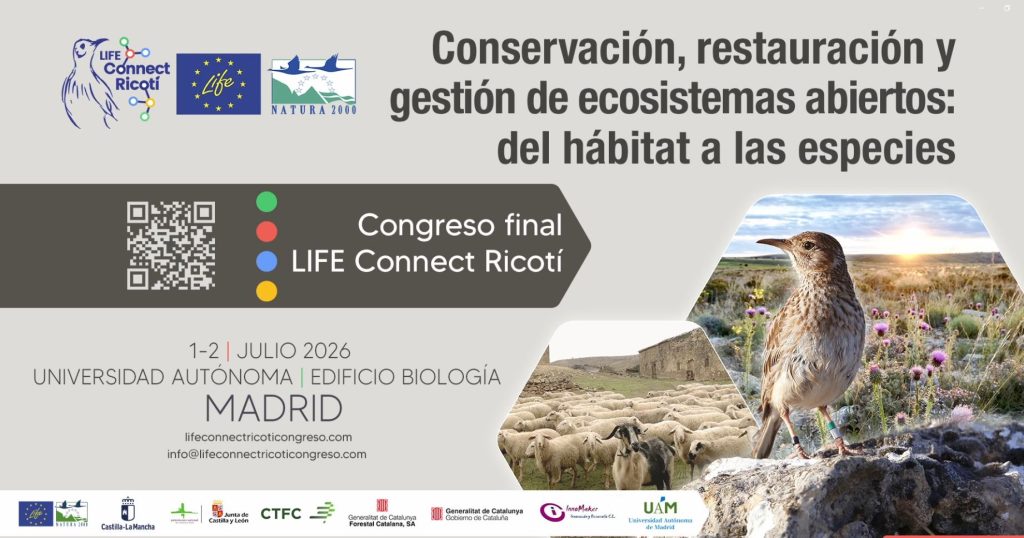
The LIFE Connect Ricotí project held its final congress on 1 and 2 July 2026 at the Universidad Autónoma de Madrid, bringing to a close five years of fieldwork with results that exceed all expectations and demonstrate that active conservation can reverse the decline of one of Europe’s most threatened birds.
Unprecedented results for Dupont’s lark
The data presented during the congress confirm the effectiveness of combining habitat restoration with population reinforcement through translocations. The most outstanding example is Embid (Guadalajara), within the Lagunas y Parameras del Señorío de Molina SPA, where the population has grown from 4 territorial males recorded between 2022 and 2023 to 35 breeding males counted in spring 2026, with numerous confirmed breeding episodes.
Equally significant results have been obtained in the Hoz del Río Gritos y Páramo de las Valeras SPA (Cuenca), where the species had been practically extinct for years. Following the release of 18 individuals and actions aimed at promoting extensive livestock farming, the area has gone from recording no individuals in 2021 to counting 9 territorial males in 2026. In Pedro Izquierdo (Cuenca), restoration and translocation measures have allowed the population to grow from zero to three territorial males in just three years.
Overall, the project has restored 610 hectares of steppe habitat, promoted the specific management of a further 600 hectares, and translocated 52 individuals between different populations.
A new European project continues the work
The success achieved has enabled the launch of a new European programme, LIFE Iber-RICOTÍ, which will run until 2032 across six autonomous communities — Catalonia, Aragon, Castilla y León, Castilla-La Mancha, Andalusia and Murcia — with the support of the Valencian Community and the Ministry for Ecological Transition and Demographic Challenge.
The area of intervention will increase to nearly 7,000 hectares. The new project plans to carry out between 120 and 150 translocations, introduce for the first time transfers between autonomous communities, develop pilot actions using controlled burns, and use horses and donkeys to keep habitats open. The most notable new development will be the launch of the first experimental captive breeding programme for Dupont’s lark, to be carried out at the Tabernas Zoo, with the aim of preventing the disappearance of the small populations that still survive in Catalonia, Andalusia and Murcia.
Congress presentations available on the website
All presentations delivered by speakers during the two days are available for download in the Documents section. The full congress video is also available in the Multimedia section.